
Spotting Before Your Period When Trying to Conceive: Is Your Luteal Phase Too Short?
When you are trying to conceive, even a small amount of spotting can create a big question: Does this mean my progesterone is low? Is my luteal phase too short? Could this affect implantation?
Spotting before your period can be worth tracking, but it does not prove that you have low progesterone, luteal phase deficiency or infertility. Timing, duration and related symptoms matter more than colour alone.
Quick answer: One isolated cycle with light spotting is not enough to diagnose a fertility problem. Repeated pre-period spotting—especially when paired with a short interval after ovulation, pelvic pain, bleeding after sex or difficulty conceiving—deserves a more complete assessment.
What Counts as Spotting Before a Period?
Spotting is light vaginal bleeding that is not your usual menstrual flow. It may appear pink, red or brown and may only be visible when wiping or as a small mark on a liner.
Brown spotting often means that blood has taken longer to leave the reproductive tract. The colour can offer context, but it cannot identify the cause on its own. If you use a fertility app, ask your fertility clinic how it defines cycle day 1; instructions can differ, especially during IVF or IUI.
Does Spotting Before Your Period Mean Low Progesterone?
Not necessarily.
After ovulation, the empty follicle becomes the corpus luteum and produces progesterone. This hormone helps prepare and maintain the uterine lining during the luteal phase—the time between ovulation and the next period.
The American Society for Reproductive Medicine's 2026 guidance on luteal phase deficiency describes a typical luteal phase as 12–14 days, with a possible range of 11–17 days. A luteal phase of 10 days or fewer may raise the possibility of luteal phase deficiency, sometimes called LPD.
However, the same guidance makes several important points:
Isolated LPD has not been proven to be an independent cause of infertility or recurrent pregnancy loss.
No available test reliably distinguishes fertile from infertile patients based on luteal function alone.
Progesterone is released in pulses and can change substantially within a short time.
A single progesterone blood result may help confirm that ovulation occurred, but it cannot determine the overall "quality" of the luteal phase.
This is why spotting—or one hormone result—should not be interpreted in isolation.
What Else Can Cause Spotting?
Pre-period or intermenstrual spotting can have several possible explanations. Depending on the timing and your health history, clinicians may consider:
Normal cycle variation or the beginning of menstrual flow
Pregnancy-related bleeding
Hormonal contraception or fertility medications
Cervical irritation, infection or inflammation
Uterine polyps, fibroids, adenomyosis or endometriosis
Ovulatory or endocrine concerns, including thyroid dysfunction
Bleeding or clotting disorders
Less commonly, cervical or endometrial precancer or cancer
Significant changes in weight, exercise, nutrition, sleep or stress
This is not a list for self-diagnosis. It shows why "spotting equals low progesterone" is too simple.
Track the Pattern, Not Just the Colour
Tracking can give your physician, fertility specialist or TCM practitioner better information. However, new or recurring spotting should be discussed while you track it; tracking should never delay care when pregnancy is possible or warning signs are present.
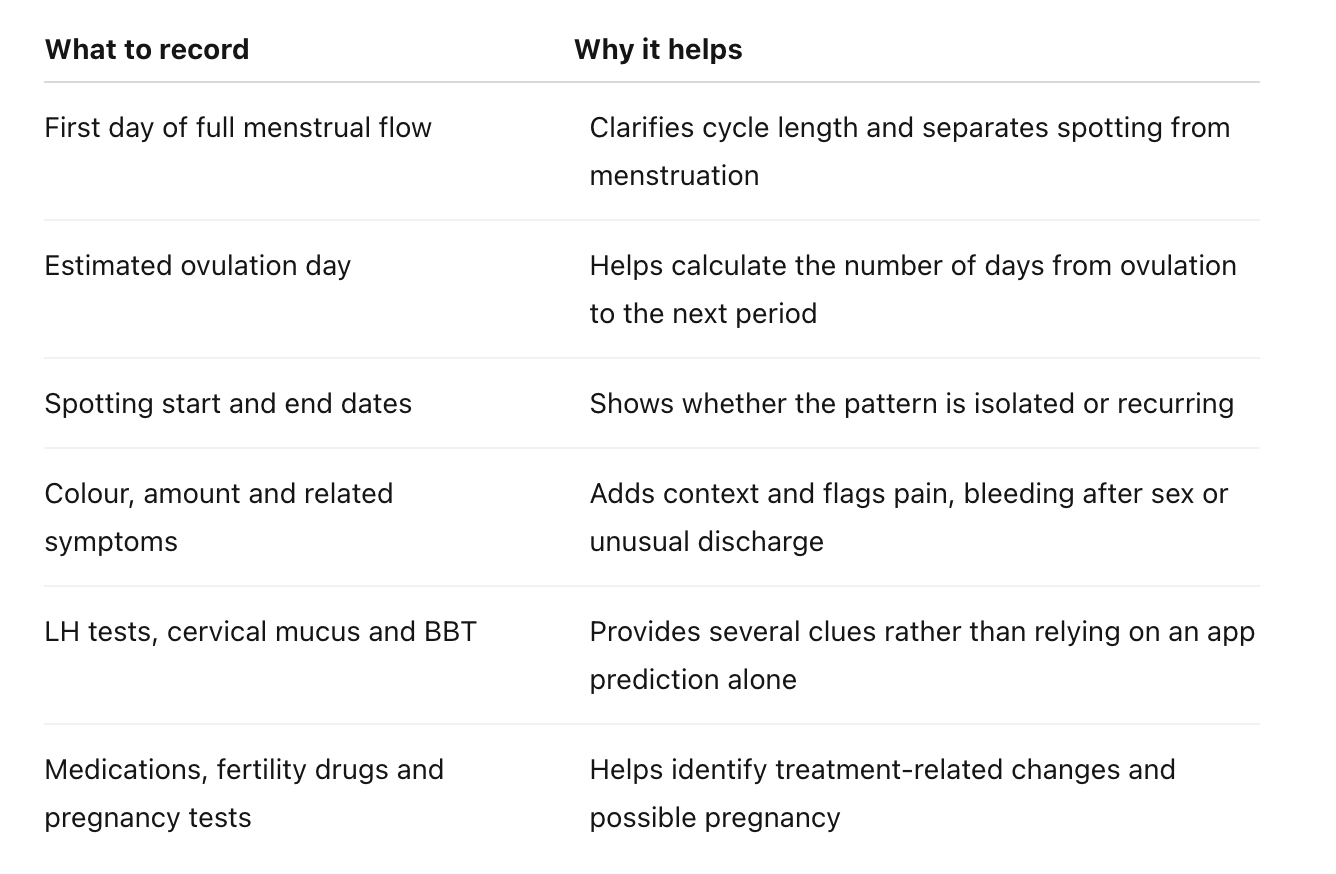
BBT can show trends, but poor sleep, illness, alcohol, shift work and inconsistent measurement times can affect the chart; it is not a diagnostic test.
When Should You Seek Medical Assessment?
Talk with your physician or fertility specialist if spotting is new, repeatedly occurs between periods or is accompanied by other symptoms. Contact your healthcare provider promptly for bleeding with a positive pregnancy test. Also arrange assessment for:
Fever, foul-smelling discharge or significant pelvic tenderness
Bleeding after intercourse that keeps returning
Spotting that persists across several cycles
Go to an emergency department or call 911 for bleeding with severe or one-sided pelvic pain, shoulder-tip pain, fainting or marked dizziness. Urgent care is also needed for very heavy bleeding, such as soaking a pad or tampon every hour for more than 2 hours—especially with chest pain, shortness of breath or light-headedness.
Depending on your history, assessment may include a pregnancy test, pelvic examination, ultrasound or appropriately timed laboratory work.
How Cycle-Aware Acupuncture and TCM May Fit
In Traditional Chinese Medicine, pre-period spotting is not treated as one universal diagnosis. A fertility-focused assessment looks at the entire cycle, including:
When the spotting begins relative to ovulation
Menstrual flow, clots, cramps and pelvic pain
Cervical mucus, BBT, sleep, stress, energy and digestion
Fertility history, pregnancy losses and current IVF or IUI medications
At TCM Fertility, care is adjusted to the cycle phase rather than repeated as a one-size-fits-all protocol. Complementary care may focus on stress, sleep, menstrual comfort and well-being while medical causes are assessed. When appropriate, herbal formulas are individualized to the person's presentation and fertility plan.
It is equally important to be clear about the limits. Acupuncture cannot diagnose low progesterone, rule out a polyp or fibroid, replace medical fertility testing, or guarantee implantation or pregnancy. Research has not established that acupuncture corrects isolated luteal phase deficiency. Herbs can interact with medicines and may not be appropriate during pregnancy. Coordinate their use with your fertility clinic, physician or pharmacist, and do not change prescribed treatment without medical guidance.
Frequently Asked Questions
Does spotting mean my progesterone is low?
No. Premenstrual spotting has been associated with luteal concerns, but it cannot diagnose low progesterone or LPD. A single progesterone result also cannot define the quality of an entire luteal phase.
Is a 10-day luteal phase too short?
The 2026 ASRM opinion describes LPD as potentially present when the luteal phase is 10 days or fewer. That finding still needs clinical context because short luteal phases can also occur in normally menstruating, fertile people.
Can I tell implantation bleeding from a period by colour?
Not reliably. Light bleeding can have several causes. If pregnancy is possible, test at the appropriate time and contact your healthcare provider if the result is positive or the bleeding is concerning.
Can acupuncture lengthen the luteal phase or raise progesterone?
Current evidence does not establish that acupuncture corrects isolated LPD or reliably raises progesterone. It may be used as supportive care for symptoms, stress, sleep and overall cycle-focused care, but it should not replace medical evaluation or prescribed treatment.
The Bottom Line
Spotting before your period is a clue, not a diagnosis. Track the full pattern, investigate persistent or concerning bleeding, and build a plan around your actual cycle rather than one symptom.
If you would like help organizing your cycle data and understanding where acupuncture or individualized TCM care may fit, book a consultation with TCM Fertility. We provide cycle-aware, complementary fertility care designed to support your reproductive health alongside your medical fertility team.
Care is provided by Mike (Weijie) Xu, R.Ac., R.TCMP, at Momentum Therapy, 15165 Yonge St, Unit 2, Aurora. The first-visit guide explains what to bring and which initial appointment to choose.
This article is for educational purposes only and does not replace medical advice, diagnosis or treatment. If you are pregnant or have unusual bleeding, contact your healthcare provider.